
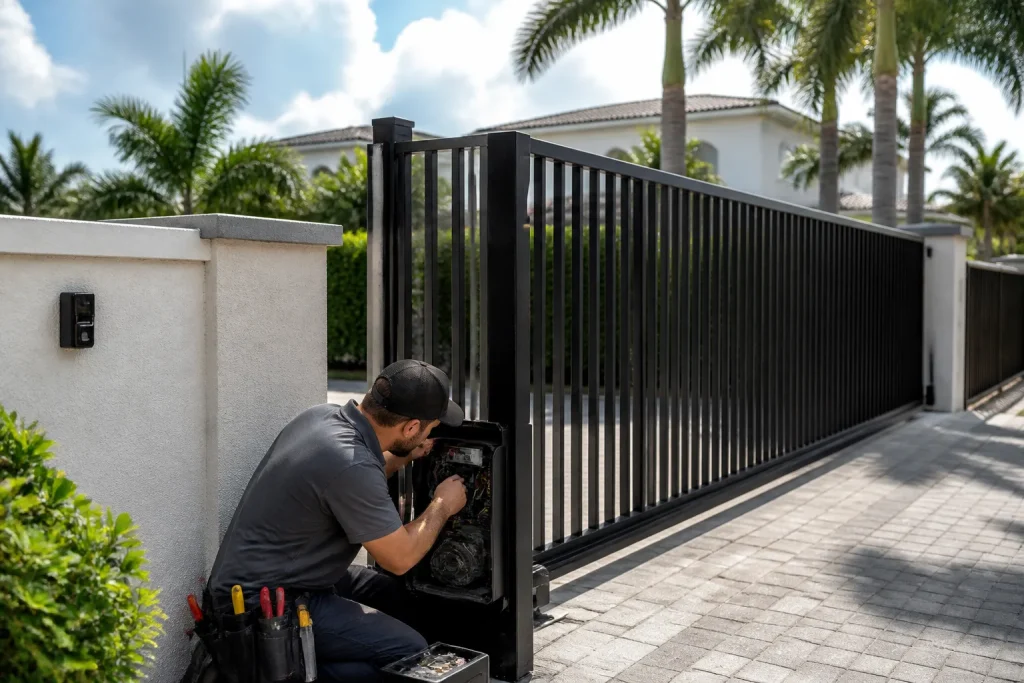
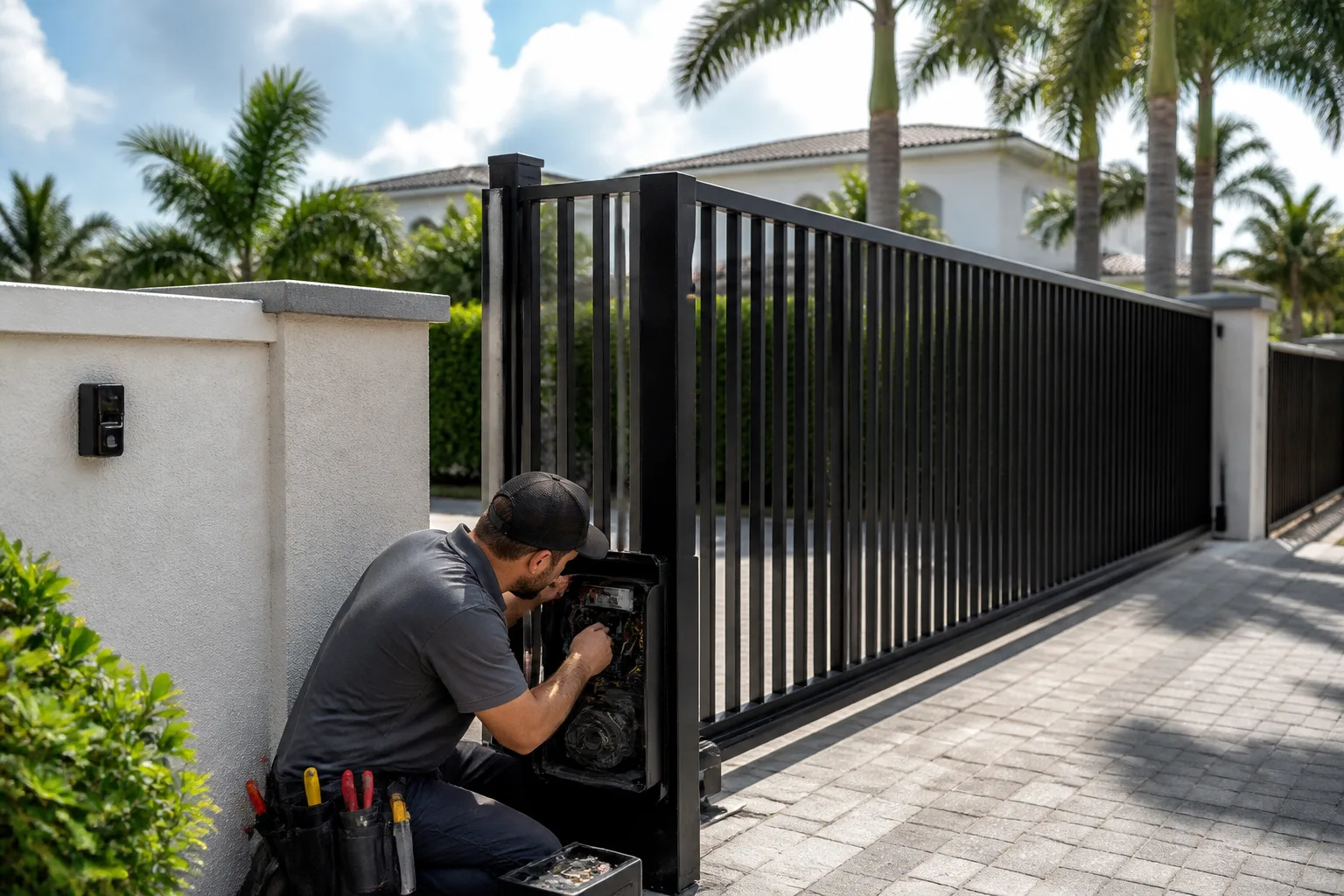
BFT Gate Repair in Miami: A Homeowner’s Guide
BFT gate repair in Miami usually comes down to one of three things: a control board that’s taken on moisture, a capacitor that’s given up after years of heat cycling, or a limit switch that’s drifted out of adjustment. Most BFT operators we see in Miami are repairable same-day once the technician actually knows the brand. If you’re standing in your driveway with a gate that won’t open, call (855) 752-6802 and we’ll get you sorted.
BFT is one of the most sophisticated gate automation brands on the market. That sophistication cuts both ways. When a BFT system works, it’s smooth, quiet, and reliable. When it fails, the failure is rarely obvious to someone who doesn’t work on BFT equipment week in and week out. And Miami’s climate adds a layer of stress that BFT’s Italian engineering, for all its precision, didn’t fully anticipate.
Why BFT Gates Fail Differently in Miami
Here’s the thing most general repair shops won’t tell you: BFT operators are built to European tolerances, and Miami’s summer humidity regularly pushes circuit board environments beyond those tolerances. We see BFT control board failures spike between June and September every single year, in a pattern that tracks almost perfectly with our dew point readings. It’s not random. It’s condensation on the board, plain and simple.
The physics work like this. During the day, the inside of the operator housing heats up. At night, the temperature drops and moisture from the air condenses on the coolest surfaces inside, which happen to be the metal traces and solder points on the logic board. Over time, that moisture causes corrosion, and corrosion causes resistance, and resistance causes the exact type of intermittent fault that makes a gate open fine in the morning, fail at noon, and work again after dinner. Homeowners call these “ghost problems.” We call it electrolysis from persistent humidity, and we see it in neighborhoods from Coconut Grove to Coral Gables every summer.
What makes this different from, say, a standard gate repair in Miami on a simpler brand is that BFT boards are dense. There isn’t a lot of space between components. A tiny amount of corrosion on the wrong trace can throw off a voltage reference and send the entire system into a fault loop that looks, to an untrained eye, like a bad motor or a dead battery.
The BFT Models You’re Most Likely to Have in Miami
Most Miami homes with BFT equipment have one of three product lines: the Virgo series for light residential swing gates, the Phobos series for heavier swing gates and some commercial applications, and the Icaro series for sliding gates. Each has its own personality when things go wrong.
BFT Virgo: Small Gate, Big Board Sensitivity
The Virgo is a compact operator designed for single-leaf swing gates up to about 800 pounds. In Miami, we mostly see Virgo units on residential driveway gates in older Coral Gables and Pinecrest homes. The motor itself rarely fails. What fails is the logic board, and it fails in a very specific way: the gate stops responding to remotes but still works from the manual release. Homeowners often assume the remote batteries are dead. They replace them. The gate still doesn’t respond. That’s almost always the receiver circuit on the board, not the remote.
The fix usually involves board-level repair or replacement, and here’s where brand knowledge matters. A BFT Virgo board isn’t something you pull off a shelf at a big-box store. If a repair company says they need to “order a universal board,” walk away. Universal boards don’t speak BFT’s diagnostic language properly, and you’ll end up with a gate that kind of works but never quite behaves.
BFT Phobos: The Heat-Cycled Workhorse
The Phobos line handles heavier gates and gets installed a lot in Miami’s newer developments where double swing gates are the norm. These units are tough, but they run hot in South Florida sun, and the component that takes the beating is the start capacitor. A failing capacitor produces a very recognizable symptom: the gate hums for a second, stops, hums again, and then either opens slowly or doesn’t open at all. When we see that on a Phobos in Miami, we know what we’re dealing with before we even open the housing.
Miami’s frequent afternoon thunderstorms add another wrinkle. Lightning strikes and grid surges travel through the power line into the operator, and BFT’s power supply section is more sensitive to voltage fluctuation than most American brands. We recommend, without exception, that every BFT installation in Miami have a dedicated surge protector at the operator’s power source. It’s a fifty-dollar part that prevents a five-hundred-dollar board replacement.
BFT Icaro: Sliding Gate Specialists
The Icaro series powers sliding gates, which are more common in Miami’s commercial and gated community settings than on individual residential properties. The failure mode here isn’t usually electronic. It’s mechanical: the rack and pinion assembly takes on grit from Miami’s limestone-heavy soil, and the gate starts to bind. The operator responds by drawing more current. More current means more heat. More heat means the thermal protection trips, and the gate stops at the same position every time, usually right at the midpoint of travel.
The dangerous misdiagnosis here is treating it as a board failure when the real problem is mechanical resistance. A technician who doesn’t know BFT will swap the board, the gate will work for a week, and then it’ll stop again. The board wasn’t the problem. The binding rack was. BFT-trained technicians check the mechanical load first because they know the Icaro’s thermal protection is doing exactly what it’s designed to do.
Reading BFT’s LED Diagnostic System Correctly
Every BFT operator has an LED diagnostic display, and it’s genuinely useful if you know how to read it. The problem we see constantly is that homeowners misread it, and unfortunately, some general repair techs do too.
The most common misread in Miami goes like this: the LED flashes a code that the homeowner looks up online, and the code points toward “low voltage” or “battery fault.” The homeowner, being practical, replaces the backup battery. The fault persists. What’s actually happening, in about half the Miami cases we see, is that the receiver board is drawing down voltage because of internal corrosion, and the symptom shows up as a voltage fault, not as a receiver fault. The battery was fine. The board wasn’t.
Here’s a quick reference for what BFT’s LED patterns actually indicate:
- Steady green: Power on, system standing by. Normal.
- Rapid flashing: Gate is in motion or a safety input is active. Normal during operation.
- Single flash, pause, repeat: Limit switch fault or travel memory lost. Needs re-programming or switch replacement.
- Double flash, pause, repeat: Obstruction detected or torque limit exceeded. In Miami, this is often the heat-related current spike described above.
- Triple flash, pause, repeat: Board communication error or firmware conflict. Not a battery problem, despite what the forum posts say.
One more note on the LED system: if the display is blank entirely and you have power at the outlet, that’s not a fuse problem. On BFT units, a completely dead display with good input power almost always means the board’s power section has failed, usually from a surge. Don’t keep resetting the breaker hoping it comes back. It won’t, and repeated surges will cook the board further.
Firmware Problems vs. Hardware Problems: Don’t Let Resets Fool You
BFT operators run on firmware, and firmware can glitch, especially after a Miami power flicker. A remote reset, or a full power cycle, will sometimes clear a firmware fault and the gate will clunk back to life. Homeowners love this because it’s free. Who wouldn’t love a free fix?
Here’s the part no one tells you: a BFT unit that requires a reset more than once a month is telling you something. Firmware faults don’t happen in a vacuum. They’re almost always triggered by underlying hardware degradation, like a weakening capacitor that’s causing brownout conditions on the board, or a sensor that’s intermittently shorting and pulling the logic into a fault state. Every time you reset the unit without addressing the root cause, you’re letting the underlying problem get worse while the gate operates in a degraded state.
We’ve had customers in Key Biscayne and Kendall who reset their BFT units weekly for six months before calling us. By the time we opened the housing, the board was scorched and the motor windings had taken damage from repeated current spikes. A three-hundred-dollar sensor fix would have solved it in March. They paid for a full replacement in September. If your BFT gate needs resets to keep running, call a specialist. Don’t keep hitting the reset button on a symptom while the cause gets more expensive.
What to Ask Any Repair Company Before They Touch Your BFT Gate
You wouldn’t let someone who usually works on Fords rebuild your Audi transmission. BFT is the Audi of gate operators. The principles are similar, but the specifics matter, and getting the specifics wrong is expensive.
Before you let any repair company in Miami open up your BFT operator, ask these five questions:
- Do you stock BFT parts, or do you order them per job? If they order per job, you’re waiting on Italian logistics, and in the middle of Miami’s rainy season, that’s a week or more with an open driveway gate. We keep BFT boards, capacitors, and limit switches on the truck because electric gate repair in Miami is what we do every day.
- Can you talk me through BFT’s diagnostic codes from memory? A tech who reaches for a manual for the most basic fault code is learning on your gate. BFT-trained techs know the codes cold.
- Do you install surge protection as part of the repair? In Miami, this should be non-negotiable. If the company says surge protection is “optional” or “extra,” they don’t understand BFT’s power sensitivity. Find someone who does.
- Will you diagnose the board at the component level, or replace it as a unit? Board replacement is clean and fast, and sometimes necessary. But a skilled tech can spot a single failed relay or capacitor and repair it for a fraction of the cost. A company that only swaps whole boards is limiting your options.
- Do you work on other brands like LiftMaster and FAAC too, or only BFT? This one seems backwards, but it matters. A company that knows BFT plus other major brands has enough comparative experience to recognize what’s normal BFT behavior and what’s a genuine fault. A one-brand shop can develop blinders.
Local Climate Factors That Affect BFT Performance in Miami
We’ve covered humidity and surges, but there are two more Miami-specific factors worth knowing about, because they explain failures that would never happen to a BFT gate in Milan or Munich.
Salt air. If you live east of Biscayne Boulevard or anywhere near the water in Key Biscayne, Miami Beach, or Coconut Grove, your gate operator is breathing salt every single day. Salt accelerates corrosion on BFT’s aluminum housings and, more critically, on the connector pins between the motor and the board. We recommend an annual inspection for coastal BFT units that includes connector cleaning and dielectric grease application. It’s preventive maintenance, not repair, and it’s the cheapest money you’ll spend on your gate.
Limestone dust. Miami’s soil is full of pulverized limestone, and in dry stretches of the year, it becomes fine airborne powder. That dust gets into the operator through the ventilation slots and settles on the optical limit sensors inside BFT’s swing-arm mechanisms. When the sensor gets dusty, the gate starts behaving erratically, stopping short, reversing randomly, or refusing to close fully. A quick sensor cleaning fixes it, but most homeowners assume the motor is dying and budget for a replacement that isn’t needed. Before you do that, have the sensors cleaned and the travel limits re-learned.
When to Call a Professional for BFT Repair
You can handle a lot of gate maintenance yourself. Lubricating hinges, clearing debris off the track, wiping down the housings, checking for visible corrosion, all of that is reasonable homeowner territory. But when you’re dealing with a BFT operator that’s behaving erratically, or you’re seeing fault codes you can’t explain, or the gate has stopped responding to remotes and the manual release works fine, that’s the moment to bring in someone who knows the brand.
And then there’s the safety line. If your BFT operator’s safety sensors aren’t functioning correctly, you have a genuine injury risk on your property. A gate that reverses late or doesn’t reverse at all can hurt someone, especially a child or a pet. We don’t say that to scare you. We say it because we’ve seen the aftermath of stuck-open safety circuits on commercial properties around Doral and Hialeah. The operators kept running while the sensors were dead, and the property managers had no idea because the gates “worked fine.” They worked too fine. They closed when they shouldn’t have. If your sensors aren’t responding, treat it as an emergency repair, not a someday project.
Related Services in Miami
If your BFT system is beyond repair, or you’re planning a replacement rather than a fix, take a look at our Gate Installation in Miami page. And if you’re not sure whether your problem is electrical or mechanical, or you have a different brand on the property, our Electric Gate Repair in Miami service covers all nine brands we work with, from BFT and FAAC to LiftMaster and Mighty Mule.
What happens when you call
- 1
A real person answersNo phone trees — you reach a local pro.
- 2
You get an upfront price rangeHonest numbers before anyone is dispatched.
- 3
A background-checked tech heads outLicensed & insured, dispatched right away.
- 4
You approve before work beginsNothing starts until you say go.
The Bottom Line
BFT makes excellent gate operators. They’re precise, they’re durable, and they’re popular in Miami for good reason. But they demand more respect than simpler brands, especially in this climate. Humidity kills BFT boards. Voltage fluctuation kills BFT power supplies. Dust kills BFT sensors. Salt air kills BFT connectors. None of these are reasons to avoid BFT. They’re reasons to maintain BFT properly and to repair it with someone who knows it well.
If you’re in Miami and your BFT gate is misbehaving, don’t reset it for the fifth time and hope for the best. Call us. Daystar Gate Repair works on BFT systems daily, we know their quirks and their fault codes, and we stock the parts that keep a BFT gate running properly in South Florida’s climate. We quote every job before work starts, no surprises, and estimates are free. Call (855) 752-6802.
Frequently Asked Questions
Most BFT repairs in Miami run between $250 and $650 depending on the failure. A limit switch replacement is on the low end. A full control board replacement is on the high end. We quote every repair before any work starts, so you’ll know the number before we turn a wrench. Call (855) 752-6802 for an exact quote, estimates are free.
Yes, in most cases. We keep common BFT parts like boards, capacitors, and limit switches on our trucks, which means the majority of residential BFT repairs in Miami are completed same-day. If your gate is stuck open or won’t close, that’s a security issue and we treat it as a priority. Call (855) 752-6802 and we’ll tell you honestly whether it’s a same-day fix.
Intermittent BFT operation in Miami is almost always caused by one of three things: moisture condensation on the control board, a weakening capacitor that fails when hot, or a dirty optical limit sensor. None of these fix themselves, and resetting the unit only masks the symptom. A BFT-trained technician can diagnose the actual cause in one visit.
We’re a full-service gate company, so we handle repair, electric gate repair, and installation. For BFT specifically, we do everything from motor replacement and control board diagnosis to full operator installation and automation setup. We service BFT alongside eight other major brands, including FAAC, LiftMaster, and Mighty Mule.
Written by the team at Daystar Gate Repair, serving Miami since 2018.
Need Gate Repair Help?
Call Daystar Gate Repair — licensed & insured, here with fast after-hours help in Miami.
(855) 752-6802