Last updated October 31, 2026
 Wrought iron
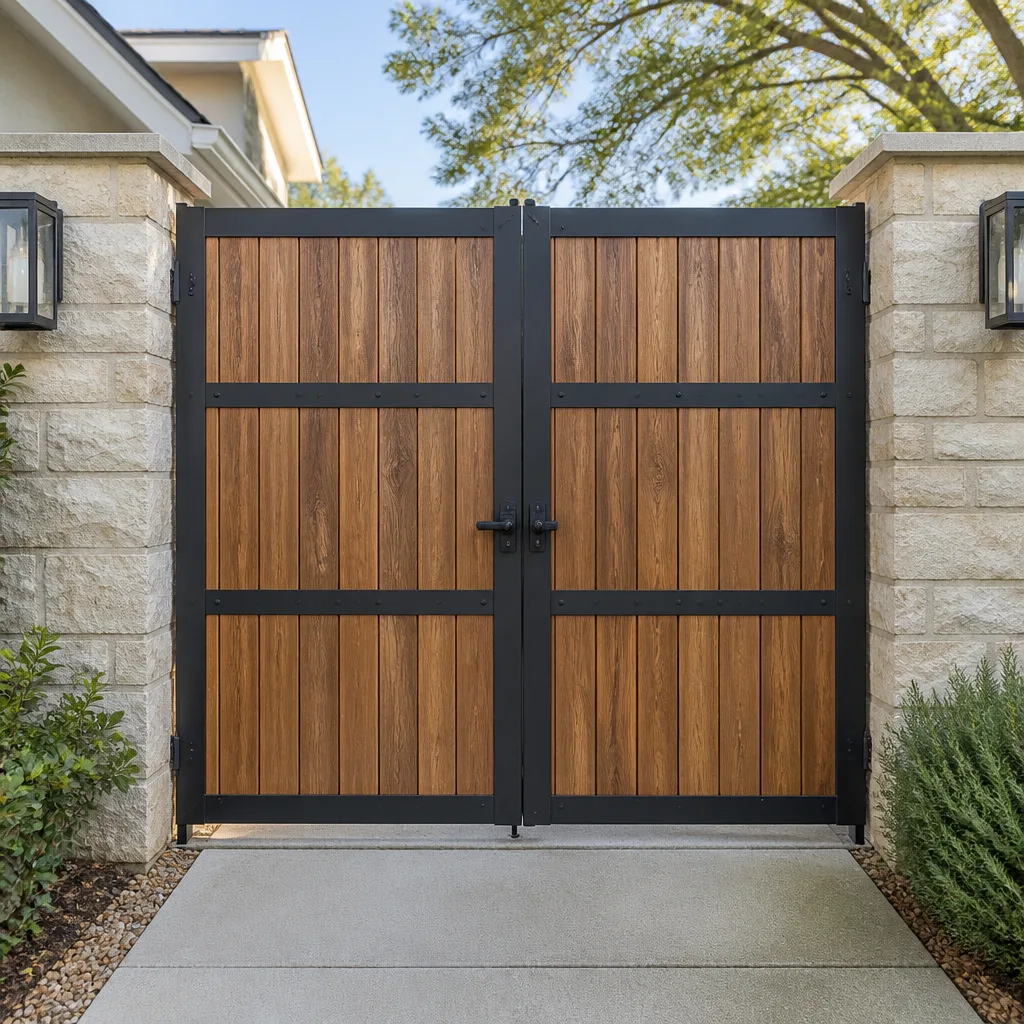 Wood & steel frame
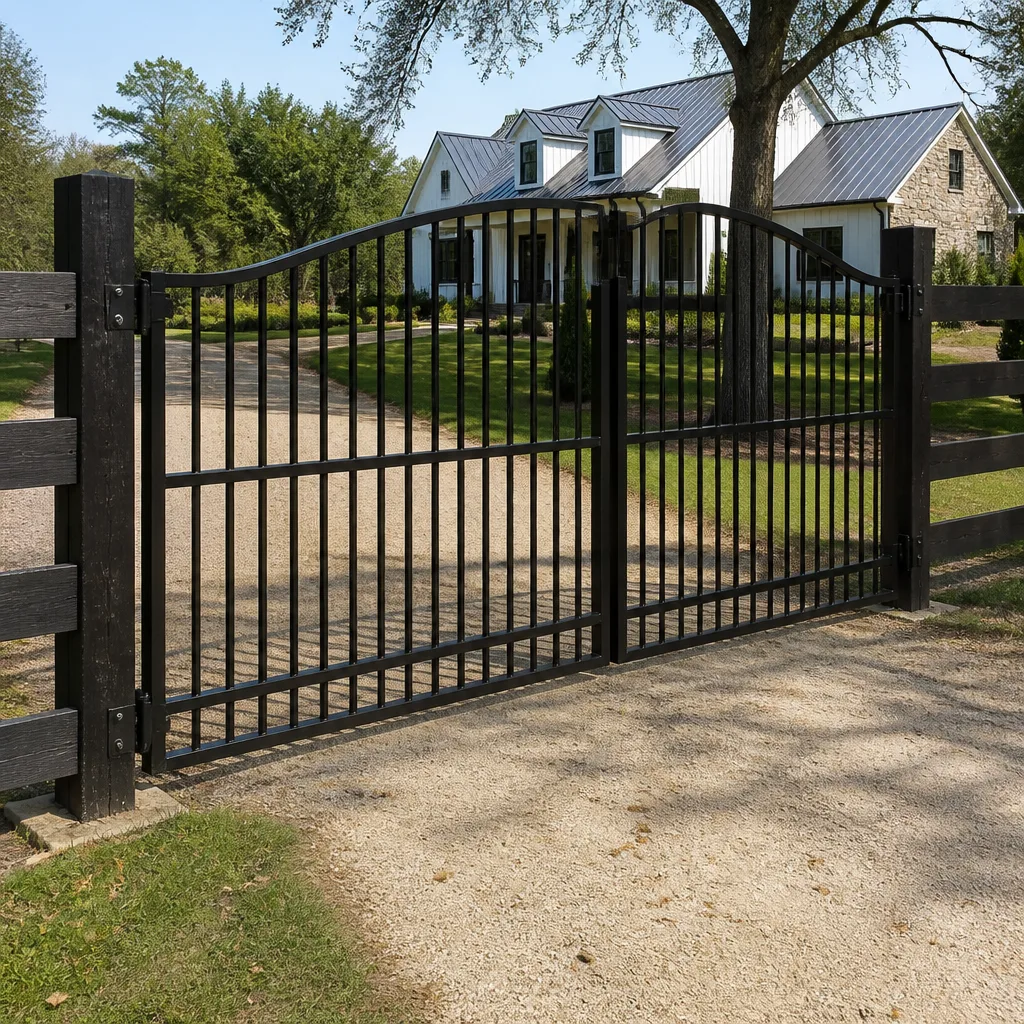 Farm & ranch
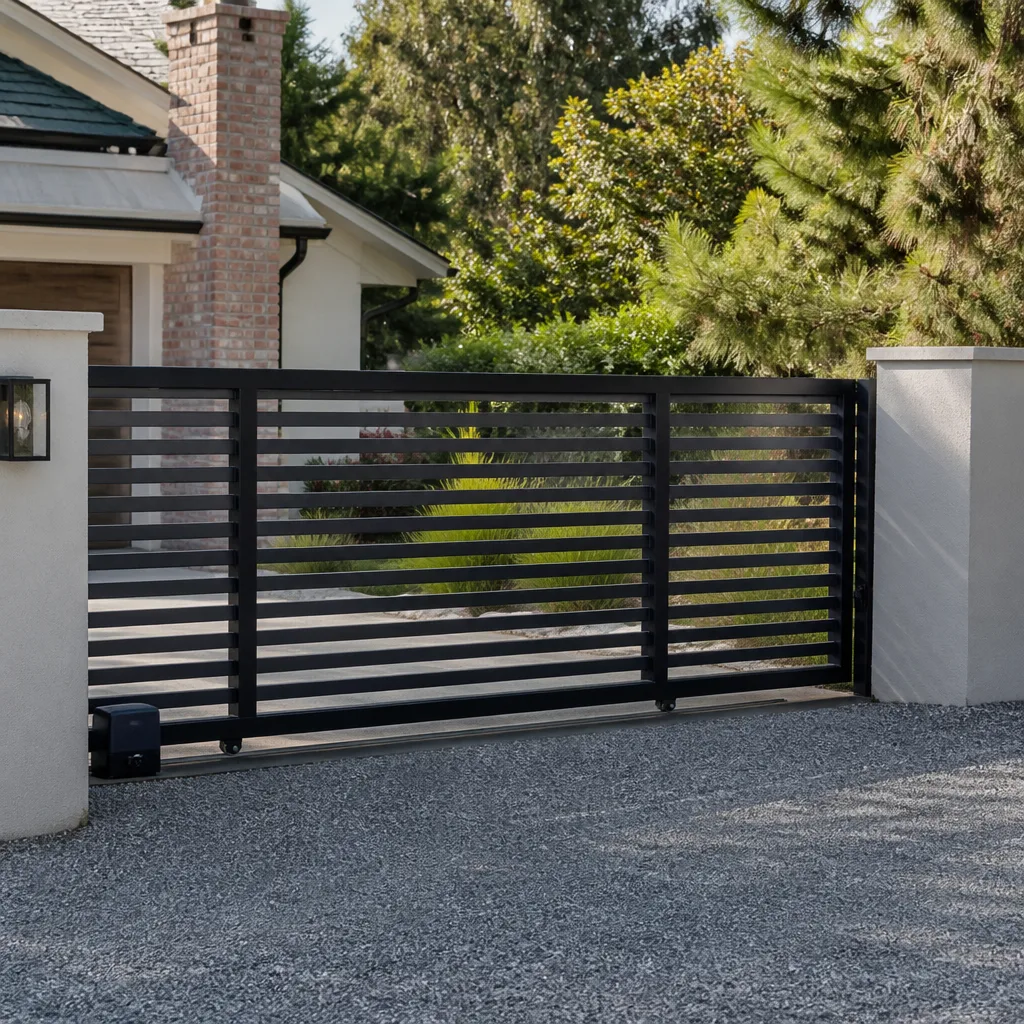 Sliding driveway gates
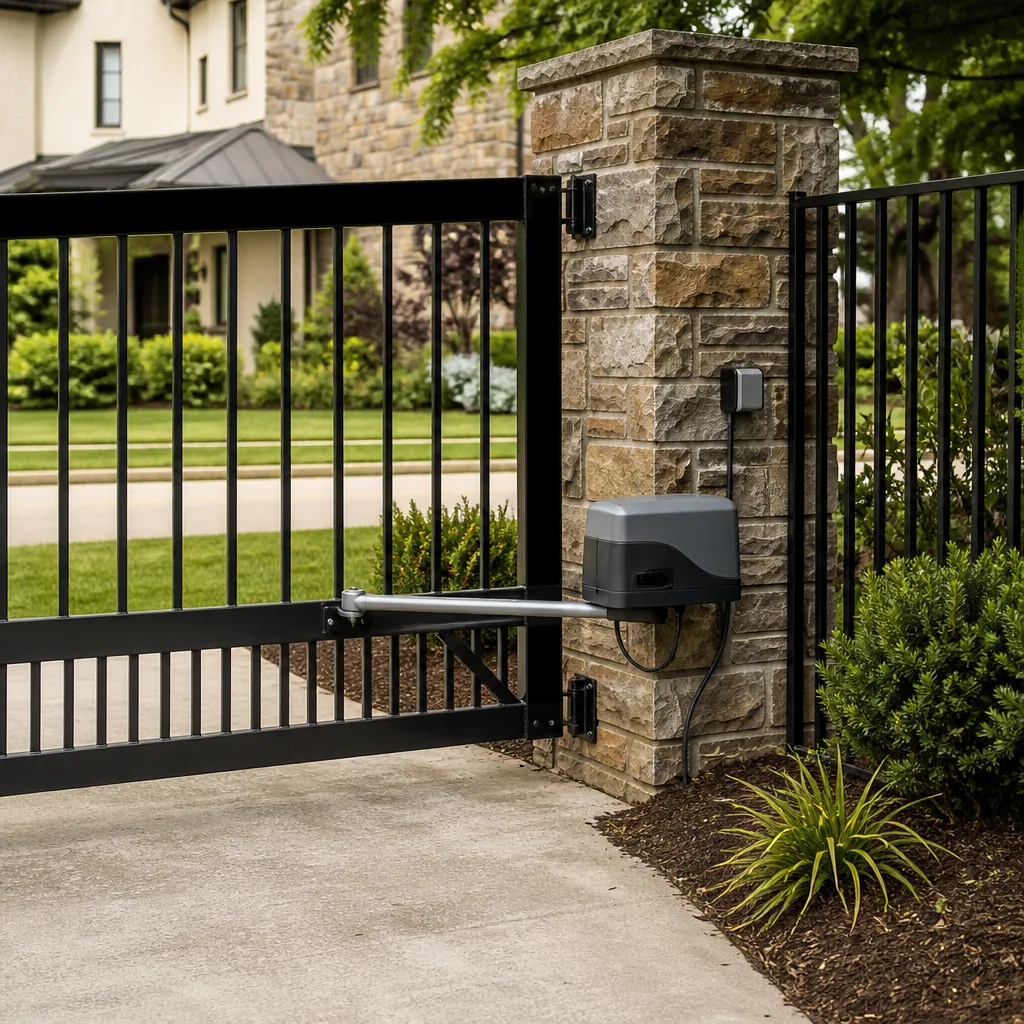 LiftMaster operators
Free on-site gate assessment - hinges, posts, and your LiftMaster or Nice gate operator checked before anything is quoted
The assessment is free and the quote is the invoice.
Get your free estimateChoosing the Right Gate Repair Brand: A Buyer’s Guide for Miami
A property manager in Brickell specified a premium European gate operator for a luxury condo, one with excellent reviews nationally and a sterling reputation in European markets. It failed 14 months into operation. The nearest certified service technician was in Orlando. The replacement control board took 9 days to arrive. In Miami, a gate that doesn’t open isn’t just an inconvenience, it’s a security breach and a resident relations crisis. That Brickell property manager learned a lesson the hard way: brand reputation means nothing without Miami parts availability and local service infrastructure. This guide covers how to choose a gate repair brand that actually works in this market, from corrosion ratings to proprietary control board lock-in.
Quick Answer
The best gate operator brand for a Miami property is one with established parts inventory and certified service technicians already operating in Miami-Dade County, plus product lines rated for salt-air corrosion and humidity, as detailed in The Complete Gate Repair Guide for Miami Homeowners. LiftMaster, FAAC, BFT, and DoorKing all maintain meaningful South Florida service networks, while some premium European brands have limited Miami presence despite strong national reviews. Verify local parts stocking before you commit, not after the gate fails.
Styles & brands we work with
Table of Contents
- Why Miami Service Infrastructure Matters More Than Brand Reputation
- Corrosion Ratings: What IP Codes and Salt-Spray Tests Actually Mean in Miami
- How to Verify a Dealer Actually Stocks Parts Instead of Drop-Shipping
- Brand Considerations for Miami’s Common Gate Types
- Battery Backup and Power Interruptions: A Miami Non-Negotiable
- Proprietary Control Boards and Long-Term Repair Costs
- Common Mistakes to Avoid
- When to Call a Professional
Why Miami Service Infrastructure Matters More Than Brand Reputation
The gate operator world splits into two tiers: brands with genuine Miami distribution and brands that sell through national retailers but lack local technical depth. A brand can have excellent reviews from homeowners in Texas or California and still leave a Miami property manager stranded when a control board fails in August. Reviews measure the product. Service infrastructure measures whether the product can be fixed quickly where you live.
In our experience working on gates across Miami, the brands that actually have technicians and parts moving through Miami-Dade County on a regular basis fall into a short list. LiftMaster has deep penetration in both residential and commercial properties, with multiple distribution channels feeding Miami supply houses. FAAC and BFT, both Italian manufacturers, maintain strong South Florida dealer networks because of the region’s high concentration of gated communities and luxury properties. DoorKing, a California-based manufacturer, has a long-standing presence in the Florida gate market, particularly for commercial and multi-family applications.
The counterexample is the premium European brand with beautiful engineering and one authorized dealer within 200 miles. When that brand’s proprietary motor fails, you wait on international shipping or a technician who covers the entire Southeast. That’s a problem for any property, but it’s worse in Miami, where gate failures compound quickly. A stuck gate blocks residents, delivery vehicles, and emergency access. Days of downtime aren’t a nuisance here, they’re a liability.
For readers comparing gate repair in Miami options, the service-network question should come before the brand-shortlist question. You’re not choosing a manufacturer. You’re choosing a manufacturer plus the ecosystem of parts, technicians, and repairs that follows it.
Corrosion Ratings: What IP Codes and Salt-Spray Tests Actually Mean in Miami
Miami’s coastal environment punishes gate hardware faster than almost any other U.S. market. Salt spray from the Atlantic, humidity that rarely drops below 70 percent, and afternoon thunderstorms that appear without warning create a corrosion cycle that eats through untreated steel, aluminum joints, and electronic connections. A gate that survives five years in Phoenix may look like it’s been through a decade in Miami after just three years near the water.
This is where two rating systems become relevant in purchase decisions. IP ratings, the ones you see as IP54 or IP65, measure ingress protection: how resistant an enclosure is to dust and water. For an outdoor gate operator in Miami, anything below IP44 is asking for trouble. IP54 means the unit is protected against dust and splashing water from any direction. IP65 means it’s dust-tight and resistant to low-pressure water jets. Those two numbers, 54 and 65, are the practical minimums for operators exposed to Miami’s weather.
Salt-spray test certifications measure something different: how long a coated metal surface resists corrosion when exposed to a continuous salt mist. A brand that references ASTM B117 salt-spray testing and specifies a coating system rated for 500 or 1,000 hours is engineering for coastal environments. A brand that doesn’t publish corrosion data is telling you something by omission. In Miami’s near-coastal zones, particularly east of US-1 in neighborhoods like Coconut Grove, Brickell, and Key Biscayne, corrosion resistance isn’t a premium feature, it’s a baseline requirement.
Brands vary significantly here. BFT and FAAC, coming from European coastal markets, generally specify their enclosures and fasteners with corrosion data available. LiftMaster’s commercial lines include stainless steel options and powder-coated finishes designed for harsh climates. The practical takeaway: ask for the IP rating and ask about salt-spray testing before you buy, and if the dealer can’t answer, that’s a signal about the depth of their technical knowledge.
How to Verify a Dealer Actually Stocks Parts Instead of Drop-Shipping
The phrase “authorized dealer” gets thrown around freely in the gate industry. It can mean a company with a warehouse full of parts and a full-time technician on payroll. It can also mean a guy with a website and a drop-ship account who orders parts from the manufacturer only after a customer calls with a problem. Both are technically factual uses of the term.
Here’s a verification process that works for Miami properties:
- Ask about physical inventory. “Do you stock control boards for this operator in your Miami location, or do you order them on demand?” A dealer who stocks parts can tell you what’s on the shelf. A drop-shipper will give you a shipping estimate.
- Ask about common failure parts specifically. Control boards, limit switches, gearboxes, and sensors are the components that fail most often. If a dealer can’t speak to stocking levels for these items, they don’t service this brand deeply.
- Ask where the dealer is physically located. Miami-Dade is large. A dealer in Homestead covering a gate in Aventura is a two-hour round trip in traffic before any work starts. Response time in Miami is geography-dependent, and a far-away dealer means a slow response.
- Ask about diagnostic capability. Does the dealer send technicians with brand-specific diagnostic tools, or do they troubleshoot by trial and error? The answer tells you whether you’re working with a specialist or a generalist.
- Ask for a Miami reference. A legitimate dealer with local history can point to properties in Miami they’ve serviced. If every reference is out of state, that tells you something.
This level of vetting matters because gate failures rarely happen at convenient times. The dealer’s real value shows at 7:30 p.m. on a Friday when a loop detector fails and residents can’t exit the property. A technician who already has the part in Miami beats a manufacturer’s perfect warranty every time.
Brand Considerations for Miami’s Common Gate Types
Miami’s gate stock splits into two primary configurations: sliding gates and swing gates. Each puts different mechanical demands on the operator, and some brands are stronger in one category than the other. Matching the brand to the gate type is more important than matching the brand to the property value.
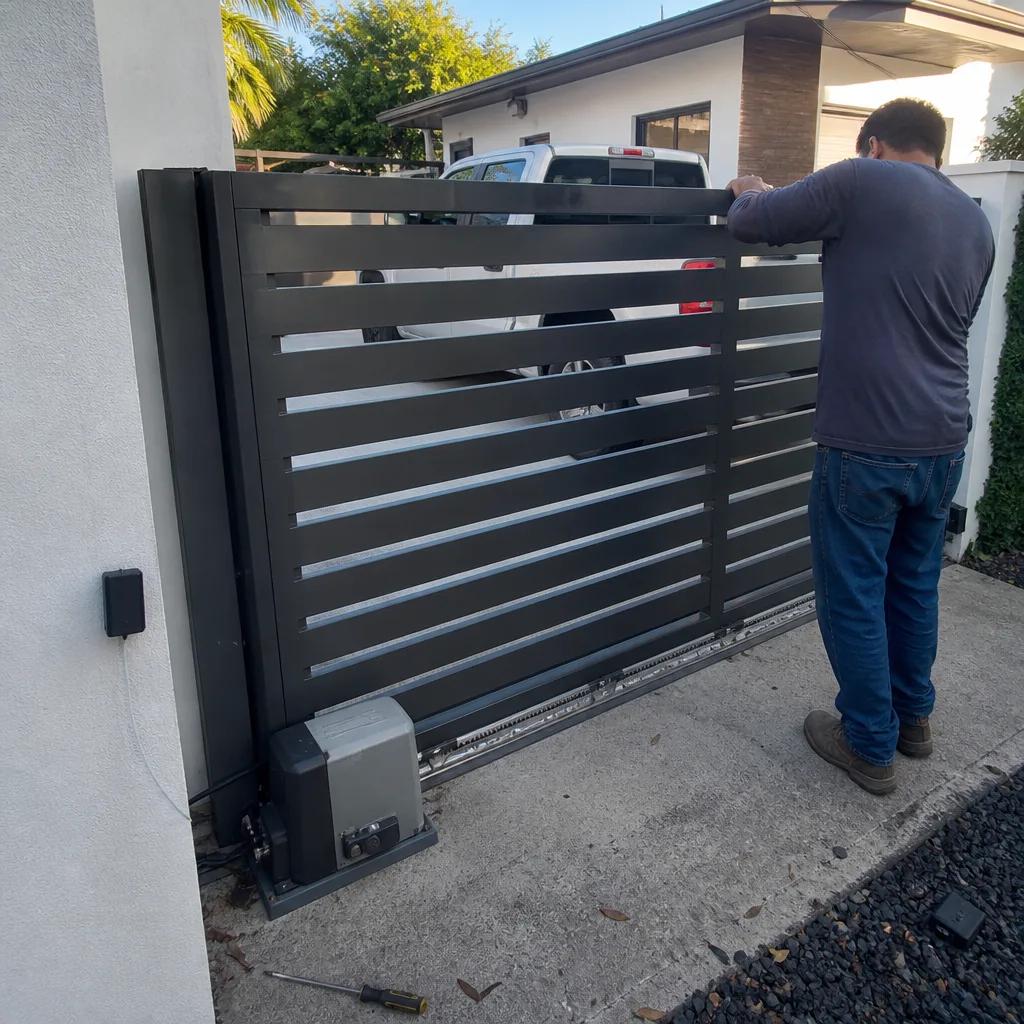
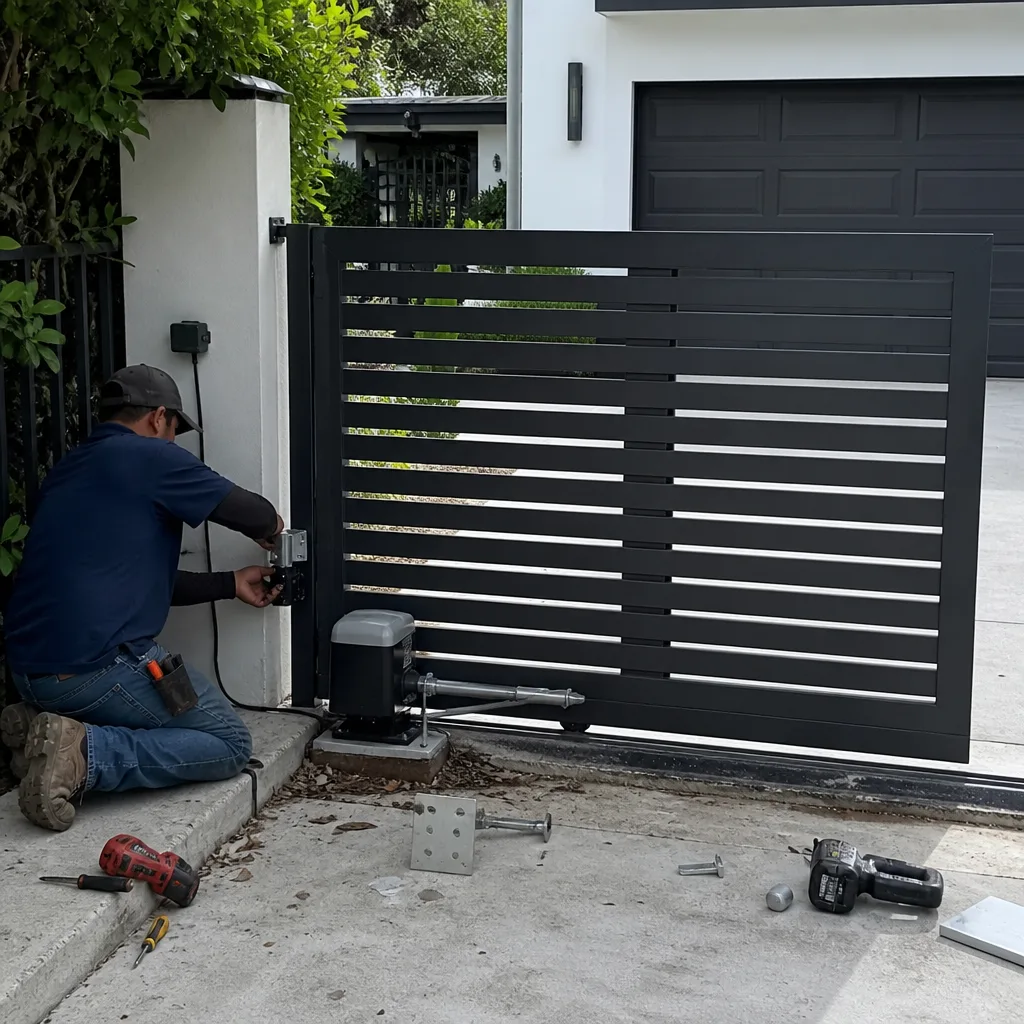
Sliding gates dominate commercial and multi-family properties across Miami-Dade. They’re common at parking garages, warehouse entrances, and the service entrances of condominium buildings. Sliding gates require operators with higher duty cycles, meaning the motor is rated to run more frequently without overheating. FAAC and BFT both build sliding gate operators that are common on Miami commercial properties, with duty cycles rated for continuous operation during peak entry and exit hours. LiftMaster’s commercial slide operators are also well represented in Miami parking structures and gated communities.
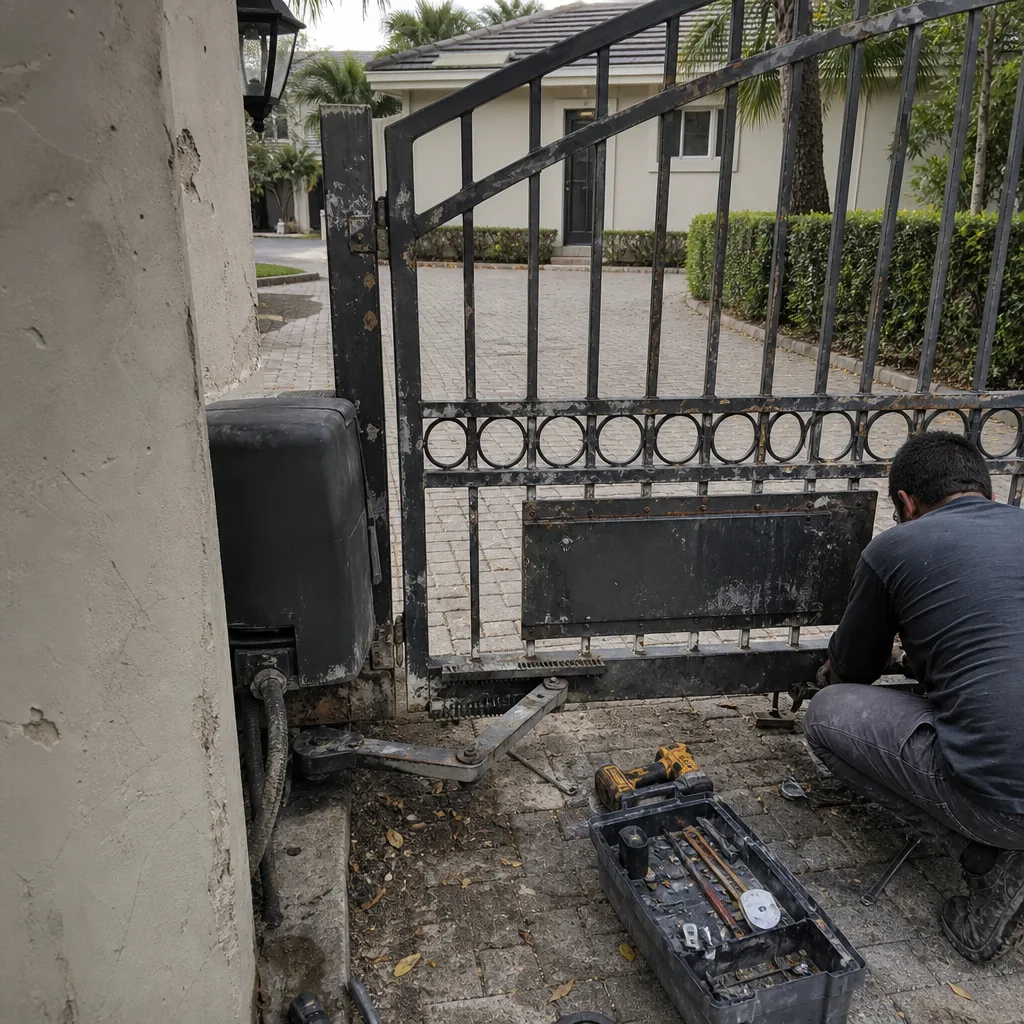
Swing gates are more common on residential properties in neighborhoods like Coral Gables, Pinecrest, and Palmetto Bay, plus smaller homeowners association entrances. Swing gate operators face different failure modes: wind loading is a bigger factor in Miami than almost anywhere else in the country, and a swing gate catching a gust of tropical storm wind can strip a gearbox or bend an arm in seconds. Ghost Controls and LiftMaster residential lines both sell swing operators that are common in Miami’s single-family market, with the liftmaster units generally offering more robust wind-load ratings.
For both configurations, the duty cycle question is critical. A residential operator with a 10 percent duty cycle means the motor runs for one minute out of every ten. That’s fine for a single-family driveway where the gate cycles a few times an hour. It’s a failure waiting to happen on a commercial property where the gate cycles dozens of times during rush periods. Brand spec sheets always list duty cycle. In Miami’s high-traffic gated communities, underspecifying duty cycle is one of the most common brand-related mistakes we see.
Battery Backup and Power Interruptions: A Miami Non-Negotiable
Miami’s power grid has a reliability problem in a way that other major Florida metros don’t. Thunderstorms knock out power for hours at a time during the summer months. Hurricanes, even when they pass offshore, leave some neighborhoods dark for days. A gate without battery backup becomes a manual operation problem at exactly the moment when property security matters most.
Most major gate operator brands offer battery backup as either a built-in feature or an add-on module. The distinction matters. LiftMaster’s commercial lines typically integrate battery backup directly into the operator chassis, while some residential units require a separate battery module installed on the gate frame. BFT and FAAC units in commercial configurations usually include backup provisions designed into the control board architecture, not bolted on afterward. DoorKing offers add-on battery backup for many of its operator models.
When evaluating brands for a Miami property, ask three battery questions. First, does the brand offer battery backup for this specific model, or only for higher-end units in the same product line? Second, what’s the rated runtime on battery power: enough for a few cycles, or enough to operate the gate through a full day of intermittent use? Third, does the battery backup system self-test, or does it require manual inspection? Sealed lead-acid batteries degrade over time, and in Miami’s heat, battery life is shorter than the national average. A battery that hasn’t been tested in two years is a false sense of security.
For gated communities and commercial properties, the backup question deserves the same weight as the corrosion question. A gate that fails during a power outage is a security breach at the worst possible moment. We’ve seen Miami properties where residents propped gates open with garbage cans after a storm knocked out power, because the backup battery had failed silently months earlier. That’s a brand choice failure as much as a maintenance failure.
Proprietary Control Boards and Long-Term Repair Costs
The control board is the brain of any automated gate system, and it’s where brand choice has the longest financial tail. Some manufacturers use proprietary control boards that only communicate with proprietary accessories. Others build open-architecture boards that accept third-party safety sensors, loop detectors, and remote receivers. In Miami, this distinction determines whether a 2 a.m. control board failure is a same-day repair or a multi-day sourcing problem.
Proprietary systems have advantages. The manufacturer controls the entire compatibility matrix, which means fewer integration problems when everything comes from the same product line. The downside shows up when a proprietary board fails and the only replacement source is the manufacturer’s distribution chain. If that chain has good Miami stock, the delay is minor. If it doesn’t, you’re waiting on a shipment while the gate stays open or stays closed.
Open-architecture systems are the alternative. A gate operator that accepts standard safety edge sensors, generic loop detectors, and universal remote receivers gives the property owner more repair options. When a component fails, you can source a replacement from any of several suppliers, not just the manufacturer. That flexibility reduces downtime and, in some cases, reduces repair cost because you’re not locked into one parts source. The tradeoff is that open systems require a technician who understands the integration points.
From a repair-cost perspective, the hidden cost of brand choice is lock-in. A property that installs a premium European operator with a closed ecosystem has already decided who can fix that gate and where the parts come from. A property that installs an operator with broad parts availability in Miami has more options when something breaks. Neither approach is wrong, but in our experience with electric gate repair in Miami, the properties that minimize downtime are the ones that thought through parts availability before installation day.
LiftMaster, FAAC, BFT, and DoorKing: Practical Brand Notes for Miami Buyers
Four brands account for most of the gate operators we service across Miami-Dade County, and each has a distinct practical profile in this market. These aren’t brand rankings. They’re observations from working on gates day in and day out in Miami’s particular environment.
LiftMaster maintains the broadest parts availability of any brand in the Miami market. The company’s distribution network pushes parts through multiple Miami supply houses, which means common failure components like control boards and limit switches are usually available same-day or next-day without freight shipping. LiftMaster’s product line spans residential swing operators, commercial slide operators, and heavy-duty industrial units, which gives property managers a single brand across multiple gate types. The tradeoff is that LiftMaster’s ecosystem is somewhat proprietary, particularly for remote access and monitoring features.
FAAC is heavily represented in Miami’s luxury residential and estate market, particularly in Coral Gables, Coconut Grove, and the waterfront properties along Biscayne Bay. The brand’s hydraulic operators handle heavy gates smoothly, which matters for the oversized, ornate iron gates common on Miami’s high-end properties. FAAC’s South Florida dealer network is well established, and the company’s corrosion resistance is generally strong for coastal applications. The brand’s hydraulic systems require more specialized service knowledge than electromechanical units from some competitors.
BFT occupies a similar position to FAAC in the Miami market: strong presence in gated communities and commercial properties, Italian engineering, and a dealer network that reaches South Florida effectively. BFT operators are common on sliding gates at condominium complexes and HOA entrances. The brand’s product line includes operators designed for high duty cycles, which matters on Miami properties where traffic doesn’t stop from 7 a.m. to 9 p.m.
DoorKing is the workhorse of the commercial gate world in Miami. The brand’s slide and swing operators show up everywhere from self-storage facilities to industrial properties to large multi-family complexes. DoorKing’s parts availability in Miami is solid for common components, and the brand’s long product lifecycles mean older installations can still source parts years after purchase. DoorKing’s boards are somewhat proprietary, but the brand’s service network in Florida is deep enough that this rarely creates sourcing problems for Miami properties.
The important distinction here is not which brand is best. It’s which brand matches your gate configuration, duty cycle requirements, and exposure to Miami’s corrosion environment. A brand that’s perfect for an inland property in Doral may be the wrong choice for a waterfront gate on Key Biscayne, not because the brand is bad, but because the environmental demands are different.
See the difference
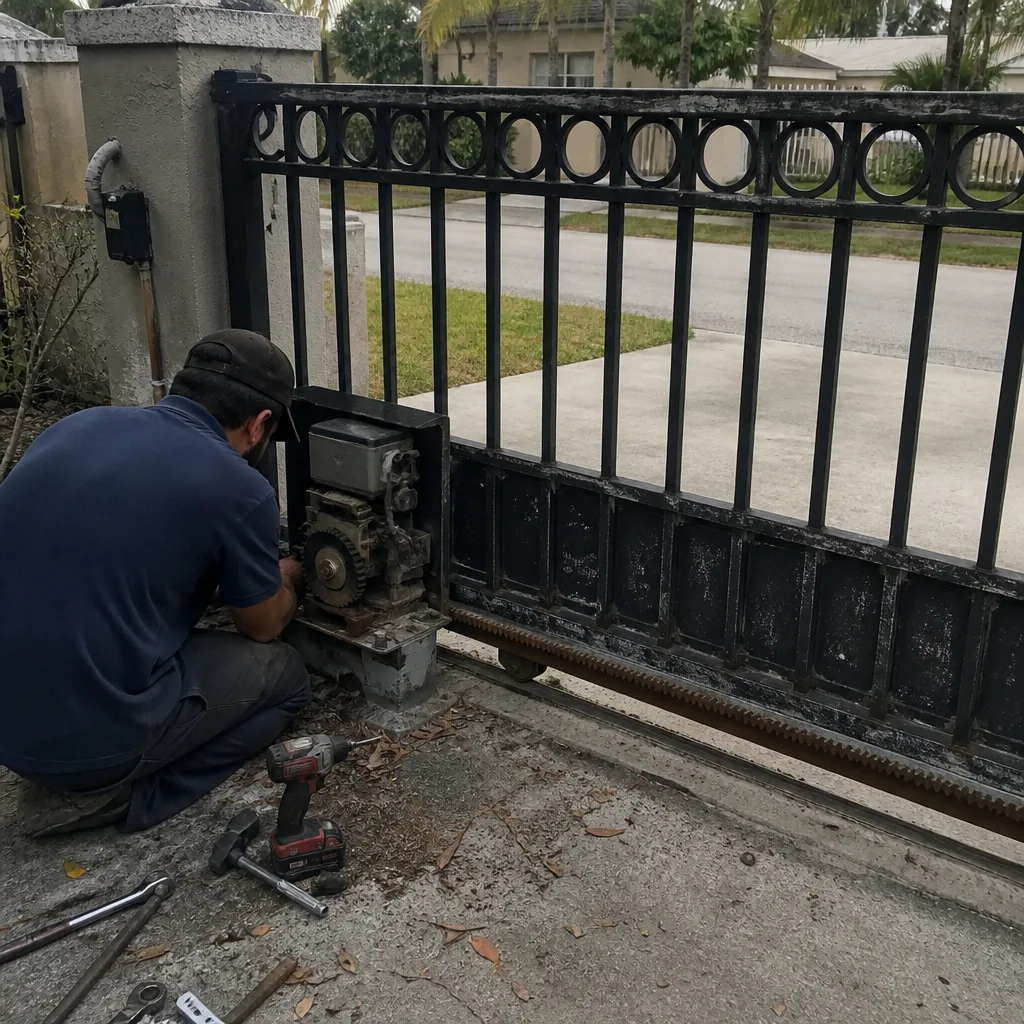 Before
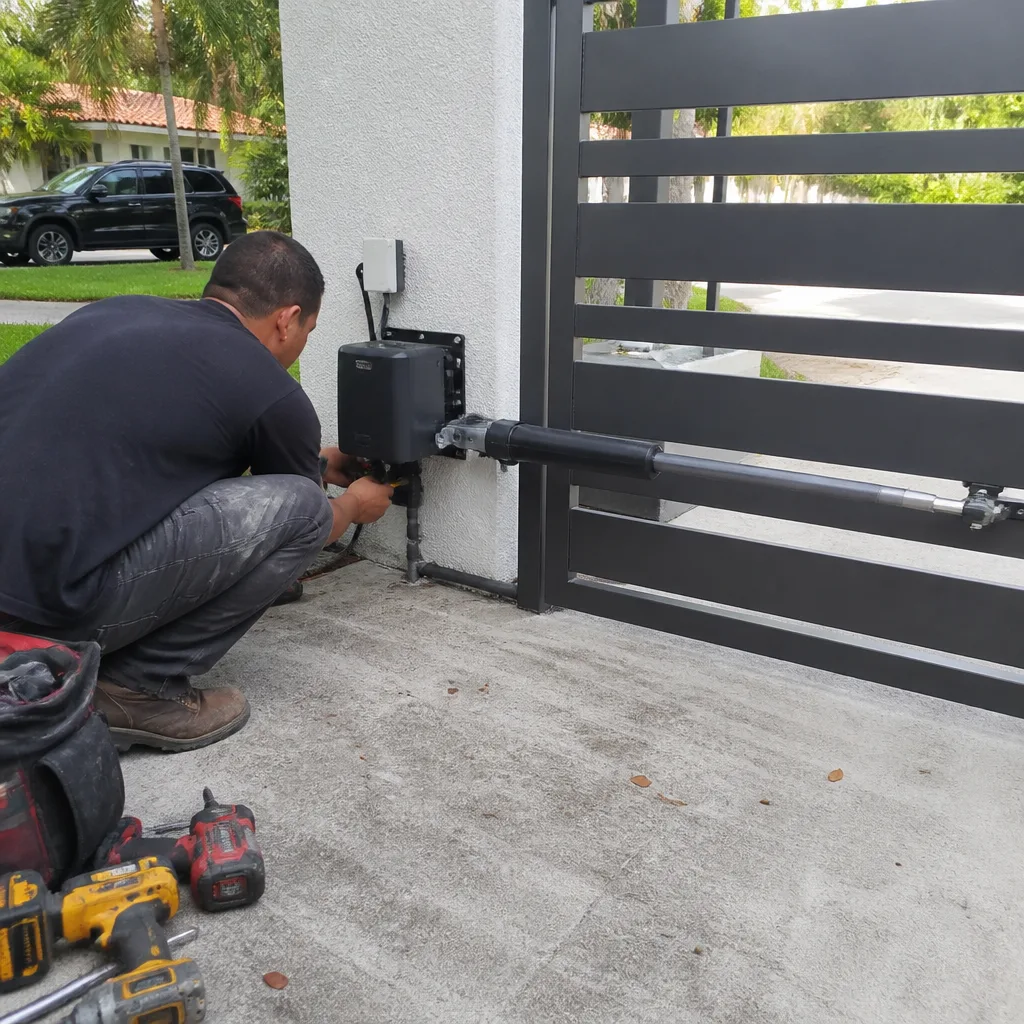 After
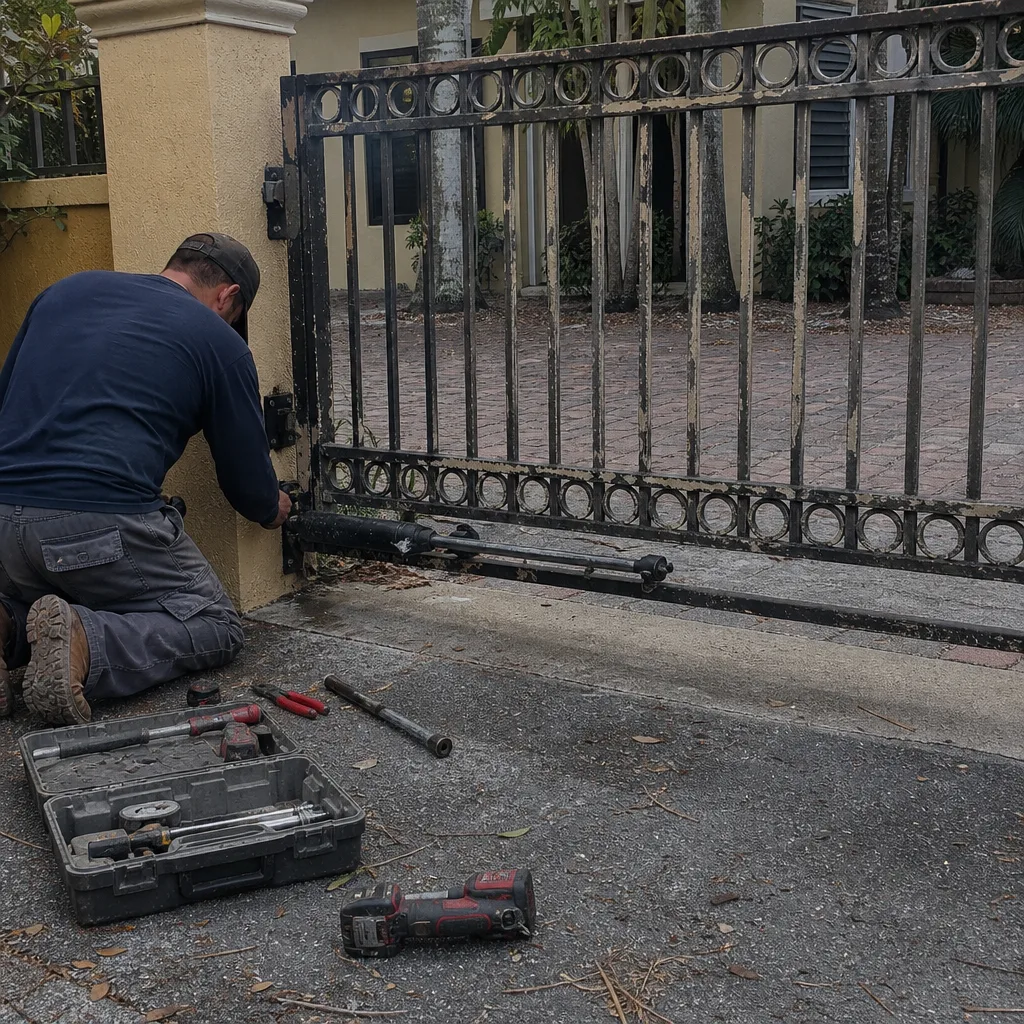 Before
 After
 Before
 After
How Brand Choice Affects Long-Term Repair Costs
Gate operators don’t fail gracefully. They fail suddenly, usually when a control board gives out, a gearbox strips, or a capacitor burns. When that happens in Miami, the repair cost equation has three variables: part availability, technician expertise, and diagnostic speed. Brand choice shapes all three.
Part availability is the most obvious variable. A brand with deep Miami parts stock means a technician can diagnose the problem, drive to a supply house, and repair the gate the same day. A brand without local parts means freight shipping, which adds both time and cost. In Miami, where many gated communities have no alternate access point, a gate that stays broken for a week forces residents to use a different route or prop the gate open. That’s not a repair cost line item, but it’s a real cost to the property.
Technician expertise is the second variable. Gate operators are not interchangeable. A technician who knows LiftMaster’s control board architecture inside and out has a steep learning curve on a BFT hydraulic system. When a property chooses a brand with few qualified technicians in Miami, every repair starts with a diagnostic question mark. That means longer repair times and, sometimes, misdiagnosed problems that lead to repeat service calls. A brand with a deep local technician pool is a brand with faster, cheaper repairs.
Diagnostic speed matters because gate problems can be difficult to isolate. A gate that opens but doesn’t close could be a safety sensor problem, a control board issue, a limit switch failure, or a wiring problem. A technician with deep familiarity in a specific brand can narrow that list quickly. One who’s seeing the brand for the first time goes through the diagnosis tree step by step, which takes longer and costs more. Brand choice determines how likely you are to have the first kind of technician available in Miami.
Evaluating Duty Cycle Claims: What Spec Sheets Don’t Tell You
Manufacturers publish duty cycle ratings that look objective but hide important context. A brand that claims a 40 percent duty cycle is telling you the motor can theoretically run for four minutes out of every ten without overheating. What the spec sheet doesn’t tell you is whether that rating assumes a specific ambient temperature, a specific gate weight, and a specific installation configuration.
In Miami, ambient temperature breaks the manufacturer’s assumptions. Duty cycle ratings are typically tested at standard temperatures, but a motor running at 95 degrees with 80 percent humidity performs differently than one running at 70 degrees in a test lab. Heat dissipation is slower in Miami’s climate, which means practical duty cycle is lower than published duty cycle. A gate on a commercial property in Hialeah that cycles 500 times a day during summer months is stressing its motor more than the spec sheet suggests.
The practical approach for Miami buyers: derate the manufacturer’s duty cycle claim by about 25 percent and ask whether the resulting number still covers your gate’s actual daily cycle count. A 40 percent duty cycle claim becomes a 30 percent practical rating in Miami’s summer heat. If your gate cycles more often than that, you need to step up a model tier or choose a brand with more thermal headroom. This is a mistake we see repeatedly on commercial properties that select operators based on the published spec rather than the Miami-adjusted spec. For additional context, see The Complete Guide to Gate Repair in Miami.
Common Mistakes to Avoid
- Choosing a brand based on national reviews without checking Miami service coverage. A brand with 4,000 five-star reviews nationally and no certified technician within 200 miles of Miami will still leave you stranded. Verify local service before you buy.
- Ignoring IP ratings and salt-spray certifications for near-coastal installations. A gate operator that’s not rated for salt exposure will corrode from the inside out in Miami’s environment. Check the ratings, especially for properties east of US-1.
- Under-specifying duty cycle for commercial gates. Miami’s high-traffic condominium and commercial gates cycle more often than homeowners realize. An undersized operator fails early and costs more in the long run.
- Skipping battery backup on an automated gate. Miami’s power interruptions are frequent enough that battery backup is a requirement, not an option. Verify the brand offers it for your specific model.
- Assuming all authorized dealers stock parts locally. Many dealers drop-ship parts on demand, which adds days to repair timelines. Ask about physical inventory before you need it.
- Selecting a brand purely for initial cost without calculating repair-cost exposure. A cheaper operator with a proprietary control board and weak Miami parts availability can cost more in year three than a pricier operator with local parts and open architecture.
When to Call a Professional
If your gate is making grinding noises, moving slower than normal, or intermittently failing to open or close, those are early warnings of a mechanical or control board problem that will get worse. If your gate stopped working entirely, or if you see a broken spring or damaged hinge, don’t attempt repairs yourself, gate systems store significant tension and can cause serious injury when disassembled incorrectly.
For Miami property owners evaluating a new gate installation or a brand change, a professional assessment helps you avoid the mistakes covered in this guide. Daystar Gate Repair specializes in electric gate systems across all major brands, and we work with both residential and commercial properties. We can evaluate your current operator, identify the brand-specific service implications in Miami, and provide a repair or replacement recommendation. For gate installation in Miami, we’ll match the brand to your gate type, duty cycle needs, and corrosion exposure. Daystar Gate Repair offers free estimates in Miami. Call (855) 752-6802.
Frequently Asked Questions
LiftMaster generally has the broadest parts availability in Miami because of its extensive distribution network and high adoption rate across both residential and commercial properties. FAAC, BFT, and DoorKing also maintain solid South Florida dealer networks with common failure parts stocked locally. The best brand for you depends on gate type and property use.
For a coastal or near-coastal Miami property, look for an IP54 rating at minimum, with IP65 preferred for units exposed to direct rain and salt spray. The higher rating means better protection against dust and water ingress, which matters in Miami’s humid, storm-prone environment. Also ask about salt-spray test certifications for the unit’s finish and fasteners.
Gate repair in Miami typically costs between $200 and $800 for common issues like sensor realignment, limit switch replacement, or control board diagnosis, while major repairs like motor replacement or full control board replacement can run from $800 to $2,500 depending on the brand and operator type. The price is quoted and agreed before any work starts. Call (855) 752-6802 for an exact quote on your specific gate system.
Daystar Gate Repair works across nine major gate operator brands in Miami, covering everything from entry-level residential operators to commercial-grade systems. For brands outside our core lineup, we can assess whether repair makes sense compared to replacement with a brand that has better local parts availability. Call (855) 752-6802 to discuss your gate.
Most major brands offer battery backup as either an integrated feature or an add-on module, with LiftMaster, FAAC, BFT, and DoorKing all providing backup options across their product lines. Explore our more guides & resources for deeper coverage of backup power planning. The key questions are whether the battery backup is available for the specific model you’re considering and how long it runs under continuous use between charges.
A well-maintained gate operator in Miami typically lasts 8 to 12 years, compared to longer lifespans in drier, cooler climates. Salt air, humidity, and frequent storm-driven power fluctuations all accelerate wear on motors, control boards, and wiring. Operators installed near the coast or on high-traffic commercial properties are likely to fall on the shorter end of that range without regular maintenance.
The Bottom Line
Choosing a gate repair brand in Miami is not about picking the highest-rated manufacturer on a national review site. It’s about matching your gate type, duty cycle requirements, and corrosion exposure to a brand with genuine service depth in Miami-Dade County. Verify parts stocking before you buy. Check IP ratings and salt-spray certifications for near-coastal properties. Plan for battery backup and the power interruptions that come with Miami’s weather. And remember that proprietary control boards have long-term repair cost implications that initial purchase price never reveals. A thoughtful brand choice now is the difference between same-day repairs and nine-day parts delays later.
Written by the team at Daystar Gate Repair, serving Miami since 2018.